UEFA AND DISNEY’S INCREDIBLE INITIATIVE TO HELP MORE GIRLS IN WALES PLAY FOOTBALL THROUGH PLAYMAKERS
Playmakers employs an innovative storytelling approach featuring much-loved Disney characters to help more girls see the fun in regular physical exercise and football.
Girls across Wales are being encouraged to kickstart a lifelong love of football through a groundbreaking Playmakers football programme from UEFA and Disney.
Using Disney’s world-renowned storytelling and inspired by academic research showing the positive role of storytelling in helping children take up sport, Playmakers aims to increase the proportion of girls meeting the World Health Organization’s minimum standards for physical activity – currently, just 16% (see WHO report).
Targeting 5-8 year-old girls not currently playing football, Wales is joining UEFA in committing to roll out Playmakers through primary schools, and local communities.
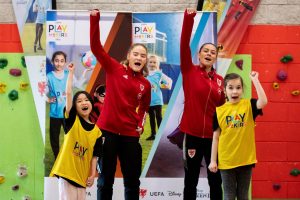
Movement, teamwork, imagination
Unlike traditional football programmes, each of Playmakers’ ten initial training sessions follow the narrative of billion-dollar global box office smash hits like Disney’s Frozen II and Disney and Pixar’s Incredibles 2. Equipped with footballs, bibs and cones, trained teachers encourage participants to play the roles of popular characters, such as Elastigirl and Elsa and Anna, bringing the films’ action scenes to life through movement, teamwork and their imagination.
FAW Head of Women and Girls Football, Lowri Roberts explained, “Our women’s football strategy Our
Wales: For Her is based on our vision to inspire confidence in women and girls to be their best self, and confidence is certainly something we see in abundance in these young girls participating in today’s launch event at Thornhill primary school. Disney Playmakers is the innovative initiative we need to get new girls into the game and ensure their first experience in the game is a positive one filled with fun and smiles!”
As Playmakers rolls out across Europe, new Disney storytelling will be added to the programme.
Creating an environment for girls to flourish
In its early sessions, Playmakers focuses on building girls’ confidence in their movement, encouraging creative thinking and communicating easily with their friends. Later sessions introduce girls to basic football skills, but the programme continues to put the emphasis on making sport fun.
Emma Salmoni, Teacher Ambassador (Thornhill Primary School) added, “I love football and have always wanted to encourage young girls into the game, I’ve never felt confident enough to coach a team and
the Disney Playmakers training really helped develop my confidence to deliver a fun football programme for the girls in Thornhill primary school and ensure that we were providing just as many opportunities for the girls as we were the boys. Nearly every girl in year 3 is attending the session weekly.”
UEFA-funded research into play-based learning
The play-based learning at the heart of Playmakers’ unique approach follows a literary review by Leeds’ Beckett University in England, which was commissioned by UEFA. The review assessed academic research into what motivates young girls to participate in sports, identifying best practice coaching methods to create a safe learning environment. Its findings put particular emphasis on the benefits of play-based education.
The programme is also the result of a knowledge-transfer partnership with the English Football Association (FA), who are currently running the “Shooting Stars” programme in partnership with Disney.
Time for Action
Playmakers represents a first step toward achieving one of the main goals of “Time for Action” the UEFA Women’s Football Strategy – to double girls’ and women’s participation in football by 2024. “If you’re going to teach football through the power of storytelling and play, you have to do it with the best stories and characters in the world, and Disney is the perfect partner for this,” said Nadine Kessler, UEFA Chief of Women’s Football.
“It is UEFA’s duty as European football’s governing body to empower girls to play the game,” added UEFA President Aleksander Čeferin. “Through this partnership with Disney, we will open up football to an audience not yet engaged with our sport.”
Disney’s Healthy Living Commitment
Across Europe, the Middle East and Africa (EMEA), Disney has a long-standing Healthy Living Commitment, using its storytelling to get families more active and working to educate and inspire children about healthy eating. This has led to a variety of partnerships on inspirational campaigns, such as Public Health England’s “10 Minute Shake Up” which inspired two million kids to “get active” and register more than 100 million extra minutes of physical activity.
In Poland, Disney launched its successful #GetMovingWithDisneyJunior initiative, a campaign spearheaded by local sporting champions, which reached more than 30,000 youngsters. The campaign involved the creation of more than 30 films, which featured children exercising alongside Disney Junior characters.
Nicole Morse, Disney EMEA’s Vice President of Integrated Marketing, said: “This brilliant Playmakers initiative is another great example of Disney’s long-term commitment to help future generations lead healthier lifestyles. By using our much-loved characters and stories as a force for good, we can really make a difference and inspire families and children to be more active. So we’re very proud that by partnering with UEFA on the first pan-European girls football programme, we will encourage more and more girls across the region to get active, build their confidence and participate in playing football, all in an environment that has been specifically designed for them.”
Parents interested in Playmakers can visit http://www.uefa.com/playmakers